

1 Take a relaxed front photo.
Use even light and opaque sportswear with your abdomen visible. Keep shoulders, waist, hips and upper legs in frame, with arms clear of your outline.


Choose your evidence, then read each method on its own terms.
Same photo as before: this is your saved result and it did not use your free estimate.
Methods disagree The photo and the formula differ by more than 5 points. They use different inputs and each has limits, so we do not average them. Check your tape placement and photo setup.
The photo and the formula are within 5 points of each other. Use both for more context.
Formulas use only the numbers you entered. They are rough guides, not a measurement of body composition.
Lean mass is derived from your weight and the Navy estimate: everything that is not fat, including muscle, bone and water. It is not muscle mass.
Optional: add your measurements to see the Navy and RFM formulas next to your photo estimate.
This estimate is saved in your account. Open your history
An estimate from one photo, not a DEXA scan. Pose, clothing and light can shift it by several points. Your photo is saved privately with your scan. Only you can see it.Zone-by-zone notes on your photo, an 8-week plan and tips for re-checks. Preview all 10 pages
Usually ready in under a minute. Your download button will appear here automatically.
You can leave this page. Your PDF will be in Account → Reports.
Photo estimate: 16–22%
Navy estimate: 19%
The tape result uses separately entered measurements. It is not calculated from the photo.

A 10-page explanation of the same free estimate.
Start with a relaxed front photo for a broad visual range, or switch to Measurements for a calculation from your own height and circumferences. Both are indirect ways to estimate body fat percentage. They use different evidence and can disagree.
Estimating body fat percentage from a photo means reading visible features with uncertainty. Navy uses neck, waist and height, plus hips where required; RFM uses height and waist with the selected sex input. Neither formula takes its measurements from the image.

Use even light and opaque sportswear with your abdomen visible. Keep shoulders, waist, hips and upper legs in frame, with arms clear of your outline.


Review the approximate range, photo quality, visible definition and contours together. Lighting, posture and clothing can change the impression.
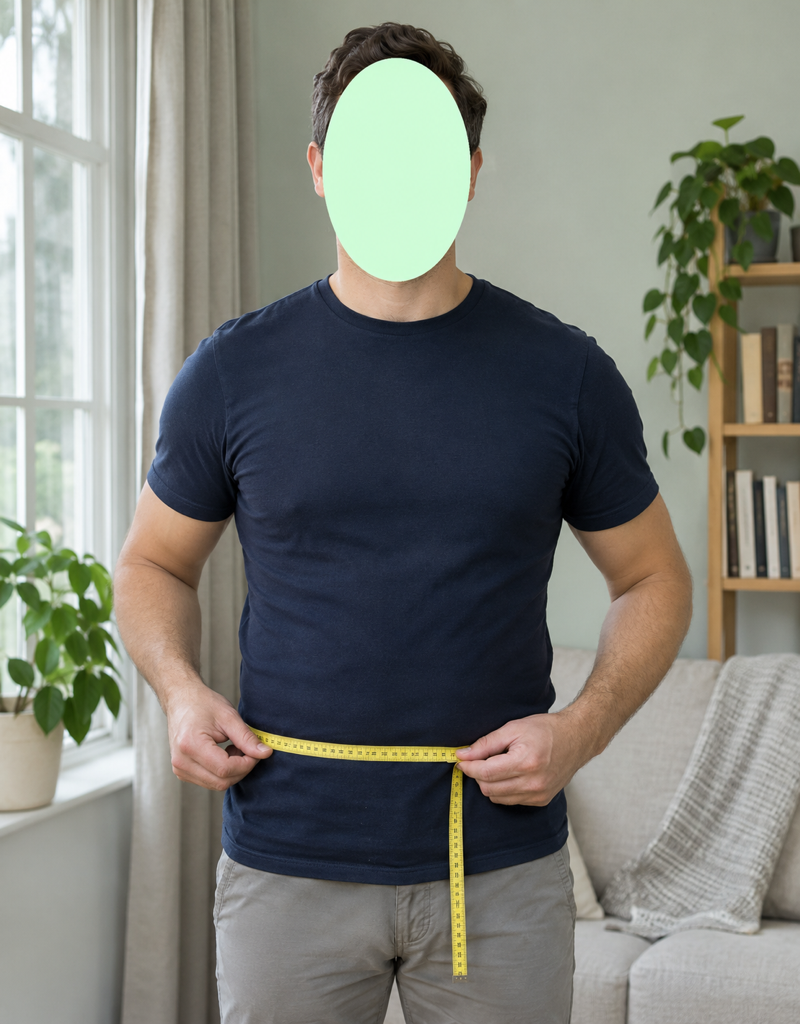

Enter height, neck and waist, plus hips when required, for a separate Navy or RFM result. Choose centimetres or inches; do not average different methods.

Illustrative check-in. The free result and paid PDF use the same estimate.
In this fictional 26–32% example, the contour note describes visible waist curve. The separate Navy value of 29% uses fictional tape inputs. These are illustrative values, not measured labels or an exact percentage.
Guests get 1 free photo estimate; a free account gets 3 in total. Measurement calculators are free and unlimited. The optional PDF uses a credit only after it is ready.
A BMI-based body fat estimate is a population formula using entered height, weight, age and sex. BMI alone does not measure body composition, and this photo tool does not infer those inputs. Measurements mode on this page provides Navy and RFM instead.
For body fat estimation at home, choose a method you can repeat consistently. Keep the photo setup stable or repeat the same tape technique. Do not average photo, tape and BMI estimates into a new percentage or treat a small shift as confirmed progress.
A broad visual estimate, with image quality and contour notes.
Separate formula estimates using the measurements you enter.
A gap greater than five percentage points is flagged when measurements accompany a photo.

Confirm that you are 18 or older and consent to processing health-related data. The browser scales the whole photo to at most 1600 px and removes metadata; it does not crop or hide your face. We store the photo privately with the scan for your account and PDF report, and send it to OpenAI, asked not to store it. You can delete it any time.
Use Measurements mode if you prefer not to upload a photo. Photo estimates cannot measure internal tissues or diagnose health conditions. They are approximate, not a DEXA scan or medical advice.
Paid reports explain the same range.
Paid packs add photo estimates and PDF reports that explain the same estimate. They do not reduce uncertainty. A report credit is used only when your report is ready.
Use a suitable front photo for a rough visual range or enter tape measurements for Navy and RFM. Read the result with the method and its inputs in mind; this is not a direct measurement.
Guests get 1 free photo estimate without registration, and a free account gets 3 in total. Measurement calculators are free and unlimited. The paid PDF explains the same result.
BMI alone cannot identify your fat percentage. A BMI-based formula also needs age and sex and remains an estimate. This page uses photos or entered tape measurements, with no personal details guessed from the image.
Photo estimates depend on visible features and setup. Tape formulas depend on measurement placement and their assumptions. Keep results separate, check inputs and avoid averaging them into a supposedly definitive value.
No. Light, posture, clothing and tape placement can shift estimates. Compare a longer pattern under consistent conditions; the broad range and notes matter more than a small numerical change.